Even most of us who grew up around
and in sight of the textile mills took them for granted.
The huge brick buildings, 4, 5 or 6 stories high, just
seemed like part of the natural landscape that had
always been there. The mills and what went on in them
were anything but natural and simple. In reality, the
workings of a textile mill, even back to the early
1900’s, was an extremely complicated mechanical system.
Even today, there are few, if any factories or
industries that are as mechanically complicated as a
textile mill was in the 1900’s. If we look at how
difficult it was to start, build and operate a textile
mill we can get a better understanding and
appreciation of them. Unfortunately, this new found
appreciation comes almost too late because most of the
industry and the big mills are gone forever.
The rural locations where most of the southern mills
were built in the late 1800’s were mostly woods or at
best, farmland. The sites, back then, were chosen to be
next to a river or large creek to provide a source of
water power to drive the mill’s machinery. Once the site
was picked, the area for the mill and its foundations
had to be excavated and leveled. The area was usually
several acres in size.
The steam shovel had been invented back then but was not
widely available. Probably, the great majority of the
earth grading and foundation excavation was done by men
using picks and shovels and horses and mules pulling
drag pans. A drag pan was a small dirt scoop that was
pulled behind a horse or mule like a plow. It did not
hold much dirt. Thousands upon thousands of drag pan
trips would have to be made in grading the site for a
typical mill.
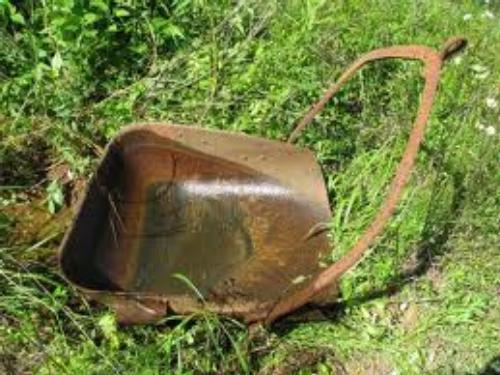
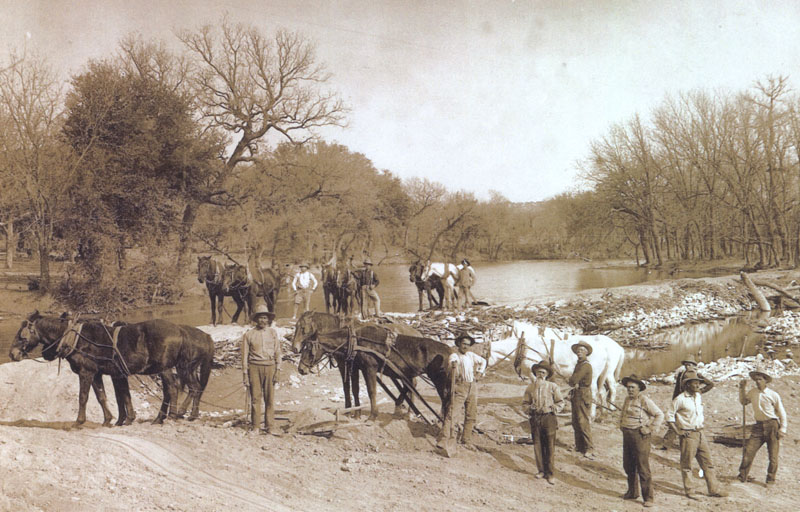
Men and horses
using drag pans. Location unknown.
Once the site had been graded, the construction of the
mill could be started. However, the design and planning
for the mill had started long before this. The mill was built as an
integrated system for the sole purpose of making cloth
on a large scale. Everything about the design of
the mill was devoted to that fact. The arrangement of
the floors, the purchase and location of all the
machinery, getting power from the water - all had to be
considered and precisely determined. Thousands of
details had to be decided. The company, Lockwood and
Greene, which still exists, designed some of the early
buildings at Pacolet
Mills.
Each mill that was built is a testimony and tribute to
all those unknown and unheralded men of every occupation
that had a part of making an idea become a reality.
There were carpenters, brick masons, stone masons,
engineers, mill wrights and many, many others.
Getting the raw materials for building the mill was a
huge and expensive hurdle. First, someone had to
determine just how much and what size material would be
required. Secondly, a source had to be found for the
material to buy it or else to make it onsite. Third,
after a source had been found, a method of transporting
the material to the mill site had to be found.
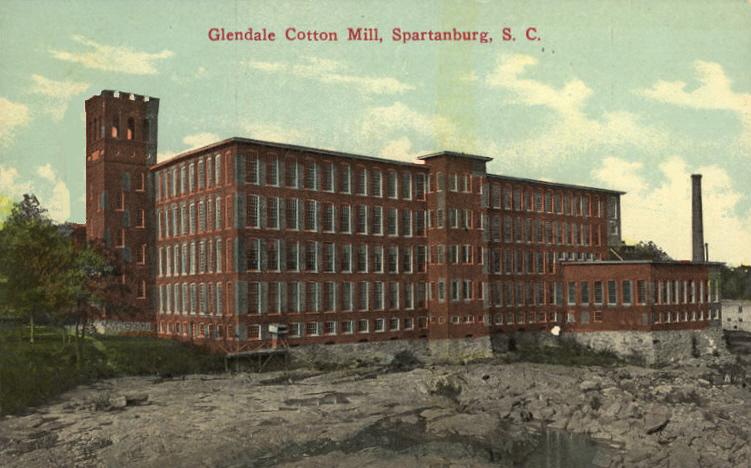
When the first mills were built at both Pacolet and
Glendale, there were no railroad connections to the mill
site. All of the material had to be brought in by horse
and wagons over rough dirt roads. Pacolet Mills No. 1
was built in 1883 and Bivingsville,
now Glendale, in 1837.
It is hard to visualize just how much of the two basic
building materials, lumber and bricks, were needed for
one of the early large mills. Tremendous quantities of
timber were used for the mill frame and floors. Many of
the timber beams had to be huge to support the loads
they carried. The heavy textile machinery vibrated as it
ran , often around the clock. If the mill was not built
strong enough, it could be literally shaken apart.
Probably ,much of the timber needed was from trees
felled and sawn close to the vicinity of the mills.
Bricks in quantities of hundreds of thousands or even
millions were needed. At Pacolet, it appears that the
bricks were built at a location close to the village. A
newspaper advertisement exists where Dr. Bivings was
soliciting brick makers and brick masons in 1837 when he
was building the first mill at Bivingsville or what is
now known as Glendale. This same ad also solicits
workers to cut and shape the timber beams used in the
mill. The advertisements are from the Greenville
Mountaineer Newspaper of 1837. One
advertisement from April, 1837 is solicting bricks and
brick masons and other workers for constructing the
mill. The second ad from July, 1837 is announcing that
the mill is in operation and now producing yarn. Both
ads can be read in detail at 1837
Newspaper Advertisements.
Construction of the mill was hard physical labor. Much
of the effort consisted of moving and lifting the tons
of building material. The foundations had to be
constructed down to the bed rock. A weak foundation
could result in the mill collapsing. Some of the very
early mills were made of wood timbers and flooring
placed on stone foundations. Others had exterior walls
made of many layers of brick but used timber for the
interior framing and floors.
In both cases, considerable effort was used in hoisting
the materials to the upper floors. Probably, most of the
lifting was done by the use of ropes and pulleys powered
by men or horses. Mill No. 2 at Pacolet was built in
1888 and was four stories or about 80 feet high. Even
with modern cranes and elevators, moving material to
this height would be difficult. It is amazing that the
builders did this just with men and horsepower.
Another aspect of building with bricks has not been
mentioned. There would be tons of mortar to be mixed,
carried and used to bond the thousands of brick
together. It is possible that the mortar was made right
on the site using lime kilns. These kilns heated
limestone rocks into lime that was used in the mortar.
However, it is more likely that at Pacolet and
even older Bivingsville, commercial mortar was
used that had been obtained from Limestone Springs near
Gaffney in what is now Cherokee County. A superior grade
of mortar was made commercially there and shipped all
over the South.
The brick masons building the high, multi-story mills
had to be not only skilled in their trade but also
brave. Some of their work involved standing on
rudimentary scaffolding 80 or 100 feet above the ground
- or the Pacolet River.
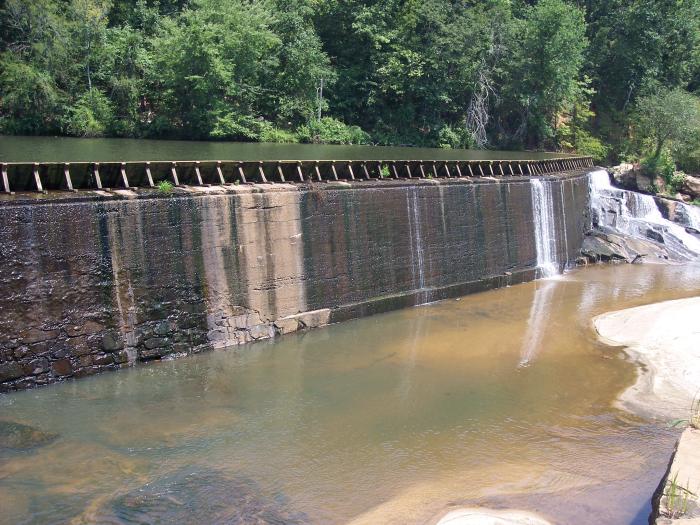 The dam at
Pacolet No. 3, "the old mill". It was built in 1891
and is still used to generate electric power today.
The dam at
Pacolet No. 3, "the old mill". It was built in 1891
and is still used to generate electric power today.
So far we have discussed building the mill. However, the
all important dam was being built at the same time or
even before the mill building. Building the dam was
truly a dangerous and critical job. Without a dam there
would be no waterpower to run the mill’s
machinery.
In building the dam, the river had to be first partially
diverted to one side of the channel by blocking the
flow. This was probably done with wagon loads of rocks.
Once this was done, half of the dam could be built in
the “dry” part of the river bed. After half the dam was
complete, the process was repeated and the rest of the
dam was built. The first dam was built for Pacolet Mill
No. 1 in 1883 and was about 100 yards long. This dam
survived the great
flood of 1903 and still stands today.
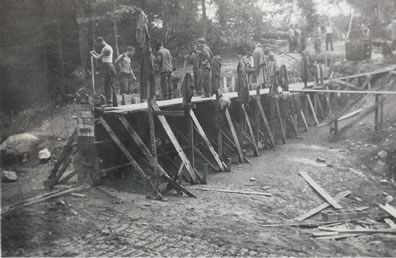 Men building a
dam - location is unknown.
Men building a
dam - location is unknown.
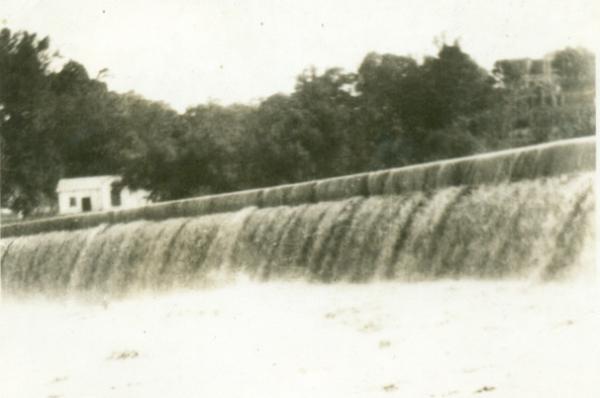
Water flowing
over the upper dam at Pacolet Mills.
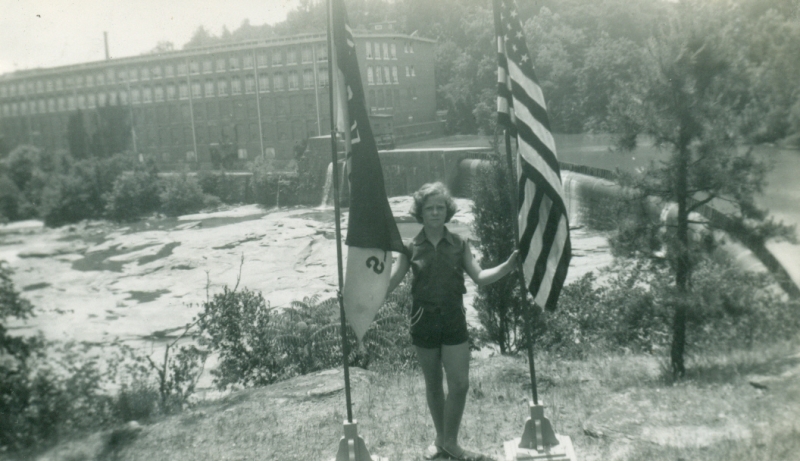 Girl Scout,
Louise Paige, with Pacolet Mills No. 5, " the new
mill", and the upper dam in the background.
Girl Scout,
Louise Paige, with Pacolet Mills No. 5, " the new
mill", and the upper dam in the background.
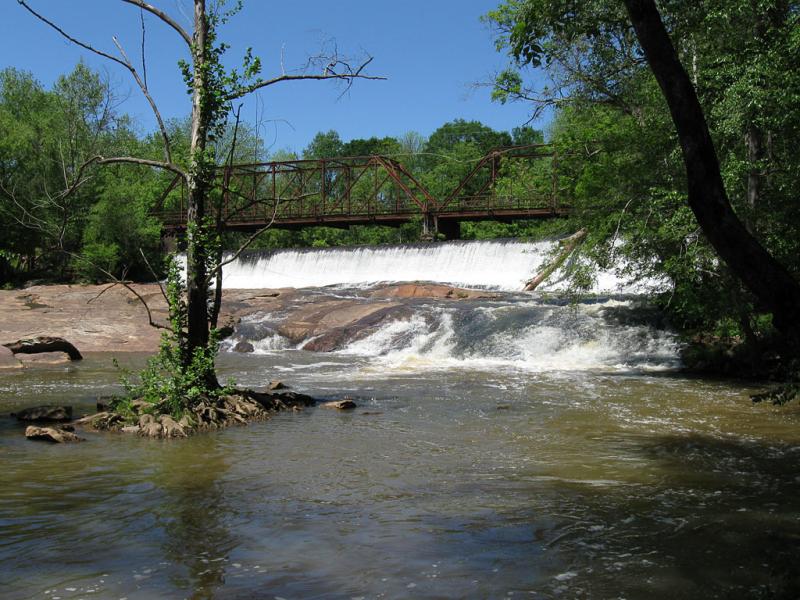
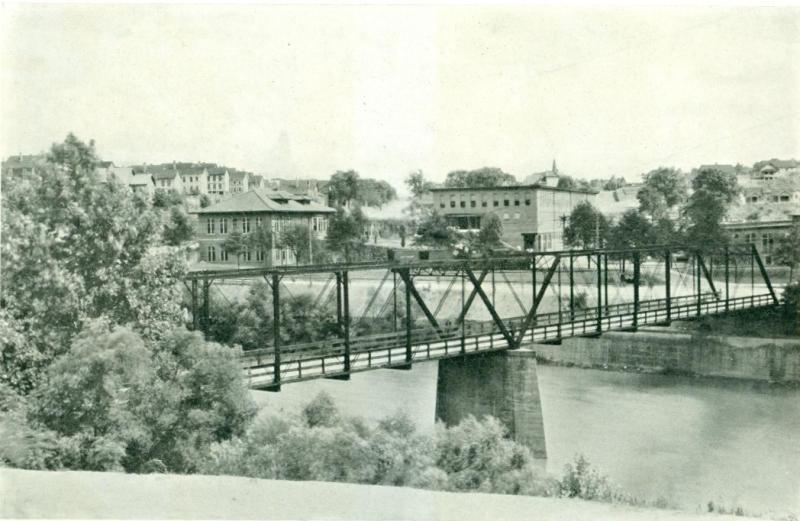
The dam at
Glendale with the old iron bridge in the background.
In the first mills, the purpose of the dams was to
increase the depth of the water and to channel a flow to
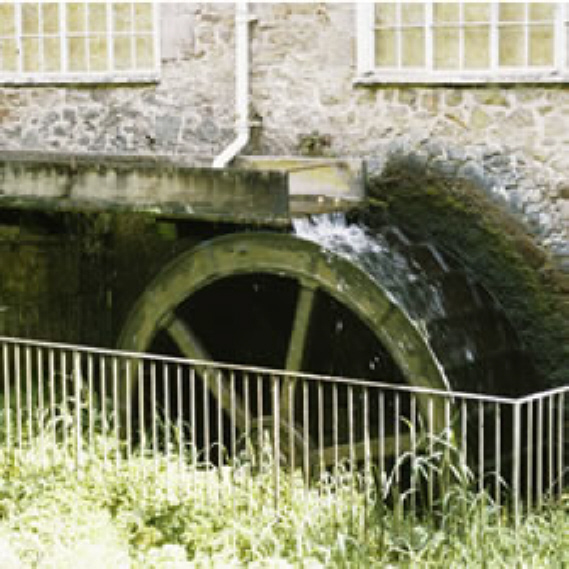
the mill’s waterwheel. The waterwheel was the heart of
the mill. There were four big waterwheels for Pacolet
Mills No. 1 and 2. The water made the big wheel rotate.
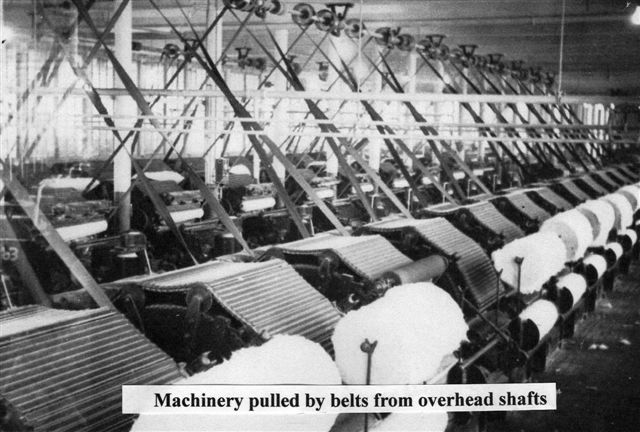
The wheel was attached to a shaft that went inside the
mill. The rotating shaft was attached to a complex
system of pulleys, smaller line shafts and flat leather
belts. These parts transmitted the power from the
waterwheel to every floor in the mill. Individual
machines such as looms were connected to the belt and
pulley system.
A waterwheel at a
mill. Not at Pacolet or Glendale.
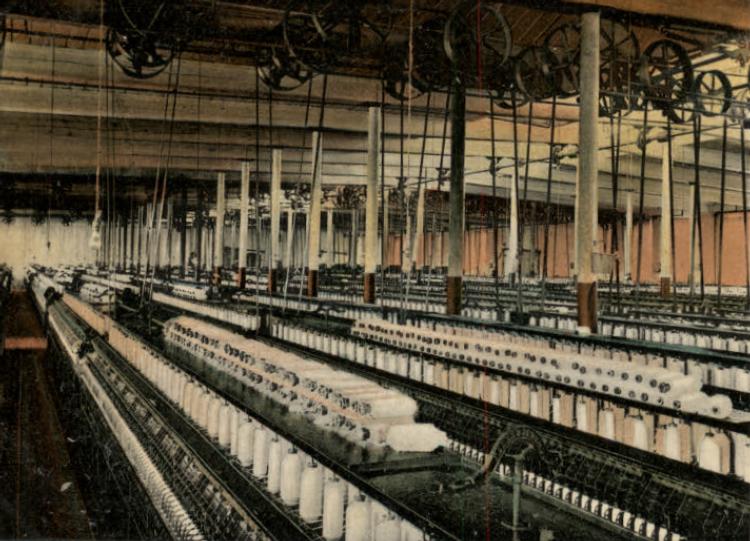
A mill, around 1900, was a complex, noisy scene of
rotating pulleys, line shafts and flat belts. For the
most part, these rotating parts were not covered. A belt
could break, come off a pulley and cause serious injury
or death to a worker.
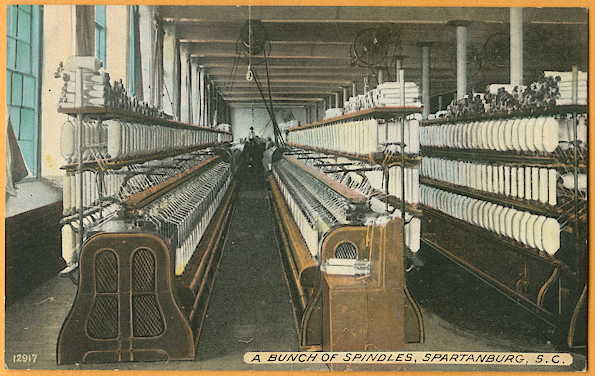
The textile machinery used in the mills around 1900 was
probably the most elaborate and complex machines that
existed anywhere at the time. They were a mass of gears,
pulleys, levers, cams and belts. All of this was usually
contained within a very heavy cast iron frame. Some of
these machines weighed several tons. Textile machinery
was always in the forefront of technology. Our modern
computers and coded data instructions can be traced back
to the Jacquard Loom invented in 1801. This machine used
cards with punched holes to control the loom to weave
cloth with complex patterns.
Mill machines not only had to have skilled operators
they also have skilled maintenance and repair workers to
keep them performing properly. Keeping the machinery up
and running was a full time job for many workers.
One of the unsung wonders of the Upcountry textile
industry was the recruiting and training of thousands of
rural workers to operate and maintain the truly complex
machinery of a textile mill.
Overtime, waterwheels were replaced with steam engines
and eventually electric motors. However, for a long
time, the system of pulleys, belts and line shafts were
still used with the new power sources. They were in use
generally until around the 1940’s when new machinery was
installed in the mills that had their own individual
electric motors.
The construction of the mill and dam was a very
important part of the project but it was not all. A
place had to be provided for the workers to live. In the
era before cars, it meant that the workers had to live
close to the mill. To allow this, the owners had to
build an entire small town or village around the mill.
This involved building houses for several hundred
workers, roads, a school,
a church, a post office, a store and other facilities. In
a period of two years or so, an open area of farmland
was turned into a new town and manufacturing operation
that gave several hundred badly needed jobs.
 Some of the
houses and other facilities at Pacolet Mills.
Some of the
houses and other facilities at Pacolet Mills.
Building a textile mill like those at Pacolet and
Glendale in the 1800’s was a supreme expression of faith
and confidence on the part of the owners and founders.
For the most part, this meant starting a new operation
where it was unknown and not widely familiar. The
following questions loomed over the heads of the first
builders. -
How will you finance the building of the mill?
Where would you find the people to design and build your
mill?
Where could you find a cheap reliable supply of cotton
in the quantity you need?
In a rural area populated by farmers, where will you
find the hundreds of workers that will be needed to
operate the complex, dangerous machinery?
Where will your workers live? Lack of transportation
means that they will have to live close to the mill.
Where will you find a reliable market for the cloth you
make?
How will you transport the raw cotton and finished
textiles to and from the mill site that only has rough
dirt roads?
These were just some of the troubling questions that had
to be answered for every one of the numerous textile
mills that sprang up in the Carolina Piedmont in the
late 1800’s In spite of all these uncertainties, the
early mill builders, owners and workers pressed on,
survived and created the once booming textile industry
of the Piedmont.