Lawson's Fork Creek
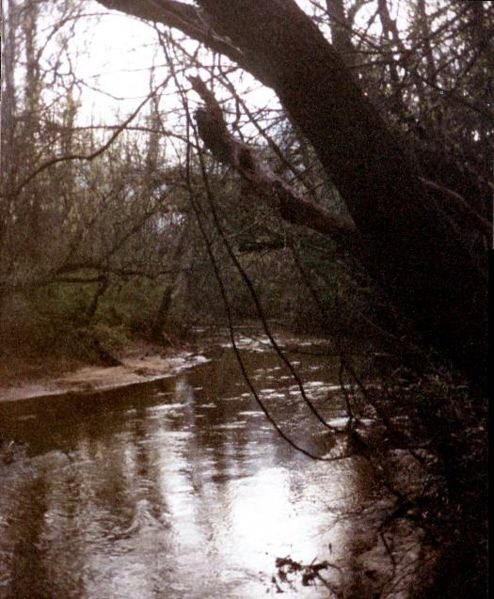
(Photo from Wikipedia)
For several thousand years, there was
little human activity along the little waterway that was to
eventually be known as Lawson's Fork Creek. Hunting parties
of Native American Indians passed over and around the area.
There was an abundance of wildlife. The Indians lived
lightly on the land. They left little to mark their
thousands of years living in the Piedmont except an
occasional stone arrowhead.
The area along the creek was part of a vast wilderness that
changed little over the centuries until the coming of the
Europeans. The first time that the creek was seen by one of
the white Europeans was about the year, 1567, when
a party of Spanish explorers under the command of
Captain Juan Pardo passed nearby. In 1934, a stone marked
with the date "1567" and direction markings was plowed up on
a farm near Inman, close to Lawson's Fork Creek. This stone
is thought to be left by Pardo's expedition and is now in
the Spartanburg Museum.
This was the first contact with the Europeans but it was
only the beginning. It started slowly at first. It was
almost another 200 years before the white men came to the
area of the creek in any numbers. In all this time, the area
near what would eventually be called Lawson's Fork Creek and
the Pacolet River remained a perfect wilderness. Around
1750, more white men came to the area. These men brought
their families and started to make settlements. For the most
part, they came down from the north, particularly the state
of Pennsylvania. They first settled on the branches of the
Tyger River, on Fairforest Creek and along the Pacolet
River. They came in increasing numbers and changed the
Piedmont forever.
The settlers worked hard to make a living and raise their
crops, particularly corn. They used the corn for food for
themselves and their animals. They needed to have the corn
ground into meal. Some of the settlers built small water
powered mills using the creeks that provided a ready source
of water power. It was during this time that Lawson's Fork
Creek got its name. The origin of who and where Lawson was
has been lost to time but evidently, the "Fork" name was
given because it flowed into and was a fork of the Pacolet
River.
For about the next 20 years or so, after 1750, only an
occasional family settled along Lawson's Fork and there was
probably a small corn grinding mill or two using the water
power of the creek. But the year, 1773, was the
beginning of using the water power of Lawson's Fork that
eventually led to what we know today as Glendale.
Over the years, Lawson's Fork has flooded many times. Click
on Flooding for more
details. Also click on Glendale
Dams, Ponds and Bridges and The
Other Bridge for more information.

This web site has been started as a
public service to share the story of Glendale.
See more information about Mary and her Glendale
connection at Mary McKinney
Teaster.